
The State of Software Tracking: How IT Teams Manage Software Assets in 2026
Table of contents

An original research report by Reftab.
We surveyed 300+ IT decision-makers on the software asset management systems in use at their organizations. SMB and mid-market teams made up 85% of the sample; the remaining 15% were enterprises with 1,000+ employees. While formal hardware asset tracking is common among respondents, fewer than four in ten actively track software in any formal way.
Most enterprise-focused SaaS management reports assume a baseline most SMB and mid-market IT teams haven’t reached yet: a complete, accurate picture of the software they already have.
The state of software tracking: five takeaways
- Most organizations aren’t really tracking software. Only 38.6% of surveyed teams have an active system to track it. Another 37.1% do it informally or ad-hoc. The rest either don’t track it at all or aren’t sure. Among SMBs specifically, one in four track nothing.
- Spreadsheets are still the default tool. 47.5% of teams that track software use spreadsheets, while only 9.8% use a dedicated software asset management tool.
- Manual effort is the dominant complaint. 52.5% of trackers name it as their biggest frustration, ahead of inaccurate data (31.4%) and integration gaps (25.1%).
- The need for tool consolidation is real. 73.3% of trackers would evaluate their existing hardware asset platform if it added real software tracking. A single platform beats best-of-breed as the stated preference, 38.0% to 20.8%.
- License waste is the problem teams most want solved. 75.4% rate identifying reclaimable software licenses as very or extremely valuable — the highest-rated capability of eight we tested, ahead of automating offboarding (73.0%).
Methodology
Reftab completed this survey in Spring 2026, collecting 337 complete responses from IT decision-makers. Two characteristics of the sample affect how the findings should be interpreted:
All respondents are existing Reftab customers, meaning every organization in the dataset already has a system for tracking hardware assets. Software tracking rates below should be read against that baseline: respondents are not a general population unfamiliar with asset tracking — they are organizations that have already implemented it for hardware, and in most cases have not extended the same discipline to software.
The sample is weighted toward SMB and mid-market organizations. Segments were defined as follows:
| Segment | Employees | Respondents | Share |
| SMB | 1–200 | 189 | 56.1% |
| Mid-market | 201–1,000 | 97 | 28.8% |
| Enterprise | 1,001+ | 51 | 15.1% |
Most existing SaaS management research — including reports from vendors serving large, SaaS-native organizations — is drawn from a different population: organizations with dedicated software budgets, dedicated headcount, and established Software Asset Management (SAM) tooling. This report reflects a segment that is larger by organization count but underrepresented in existing research.
Respondents were also asked about their role in purchasing decisions: 84.3% either influence or make final decisions on software and platform purchases (55.2% influence or recommend; 29.1% decide outright).
Statistical note: All percentages reported here are calculated from a base of at least 30 respondents. Where a finding applies to a subgroup, the base is stated explicitly. Findings drawn from smaller subgroups are described using raw counts rather than percentages, to avoid implying a level of precision the sample size does not support.
The software tracking gap by segment
Among survey respondents, 38.6% actively track software, 37.1% conduct informal or partial tracking, 18.4% do not track software at all, and 5.9% are unsure of their organization’s practices.
This gap is not evenly distributed across segments:
- SMB: 25.4% do not track software at all
- Mid-market: 9.3% do not track software at all
- Enterprise: 9.8% do not track software at all
Smaller organizations are roughly two-and-a-half times more likely to have zero software visibility than mid-market or enterprise organizations. The most commonly cited reason for not tracking software was organizational priority:
- 43.9% of non-trackers said it is not currently a priority.
- 14.6% cited lack of time or resources.
- 14.6% said they do not know where to start.
This stated reasoning contrasts with reported outcomes. Among the respondents who do not track software, 60% report having experienced at least one negative consequence as a result — most commonly, paying for software licenses that were not being used. Other reported consequences include employees using unapproved applications without IT’s knowledge and, in isolated cases, a failed compliance audit related to software.
Over 40% of non-tracking IT teams say software management is not a current priority. The majority have already paid for that decision through unused software licenses.
How teams track software and why visibility remains incomplete
Two factors explain why coverage remains incomplete beyond the top-line tracking-maturity numbers: tracking methods built for other purposes, and a software management tool category not designed for this segment. Software asset management has historically developed as a discipline and tool category separate from IT asset management (ITAM), even though the two describe overlapping parts of the same environment. That separation is visible throughout this data.
Tracking methods are scattered. Among teams that track software in any capacity, spreadsheets are the most common method at 47.5%, ahead of hardware and asset management platforms (41.6%), MDM or endpoint tools repurposed for the job (21.6%), and IT service management platforms (18.8%). Dedicated software asset management tools appear in 9.8% of trackers’ workflows. Across the full sample, only 7.4% of respondents named a specific major SAM or SaaS management platform (Torii, Zluri, Flexera, ServiceNow SAM, and similar tools, combined)
Visibility varies by software category. Desktop applications on company devices lead at 83.9% visibility. This category is the easiest to see, since it lives on a device IT already manages. Visibility drops from there: cloud and SaaS applications, 52.5%. On-premise or server software, 39.6%. Security software, 37.3%. Developer tools and licenses, 31.4%. Mobile applications, 28.6%. Browser extensions, 22.7%.
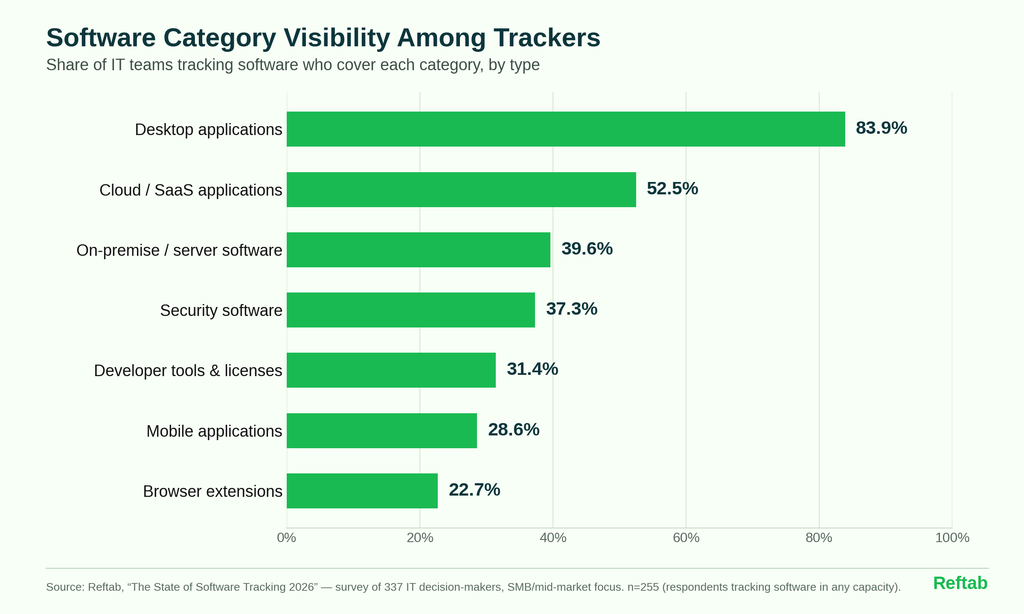
The data points to a tooling shortfall more than a discipline problem, and adoption of dedicated tooling correlates directly with company size. Dedicated SAM tool adoption climbs from 6.2% of SMB trackers to 9.6% of mid-market trackers to 21.4% of enterprise trackers. This reflects how SAM platforms are priced and marketed: for organizations with dedicated software budgets and headcount that most SMB and mid-market IT teams lack.
Visibility follows what’s easy to check, not what represents security or budget risk.
The cost of manual software tracking
Teams that track software report frustration with the effort involved. 52.5% of trackers cite manual effort as their biggest frustration, ahead of inaccurate or incomplete data (31.4%) and poor integration with other systems (25.1%). Managing multiple disconnected tools is its own complaint for 16.9% of trackers, and 12.9% cite limited automation.
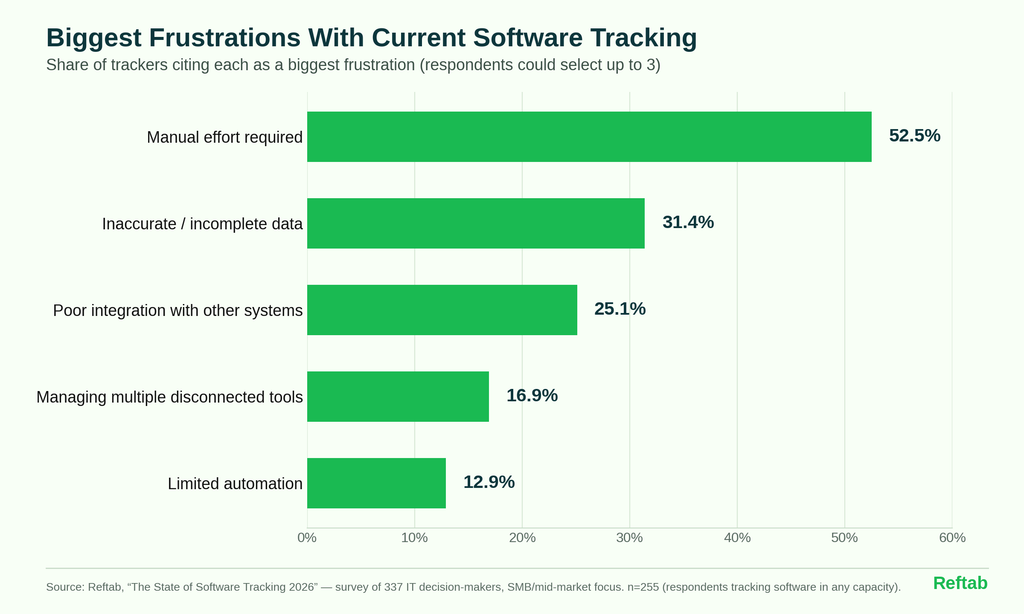
A satisfaction paradox is evident in the data: only 14.1% of software trackers describe themselves as dissatisfied with their current approach, despite manual effort remaining the top complaint. This gap between stated satisfaction and reported effort suggests organizations have normalized a faulty and laborious manual process rather than resolved it.
Demand for automation is high: 56.5% say it’s very or extremely important that a software tracking solution take action automatically — revoking access, triggering offboarding workflows — rather than only generating a report. Roughly 12% say reporting alone is sufficient. This demand also scales with company size: 52.3% of SMB trackers rate automation very or extremely important, compared with 59.0% of mid-market trackers and 64.3% of enterprise trackers. For most trackers, automated remediation is a higher priority than improved reporting. That priority grows as organizations grow, tracking the same pattern seen in the capability rankings below.
What IT teams want in a software tracking solution
When asked to rate the value of eight specific capabilities, respondents ranked license recovery and offboarding automation well above the rest.
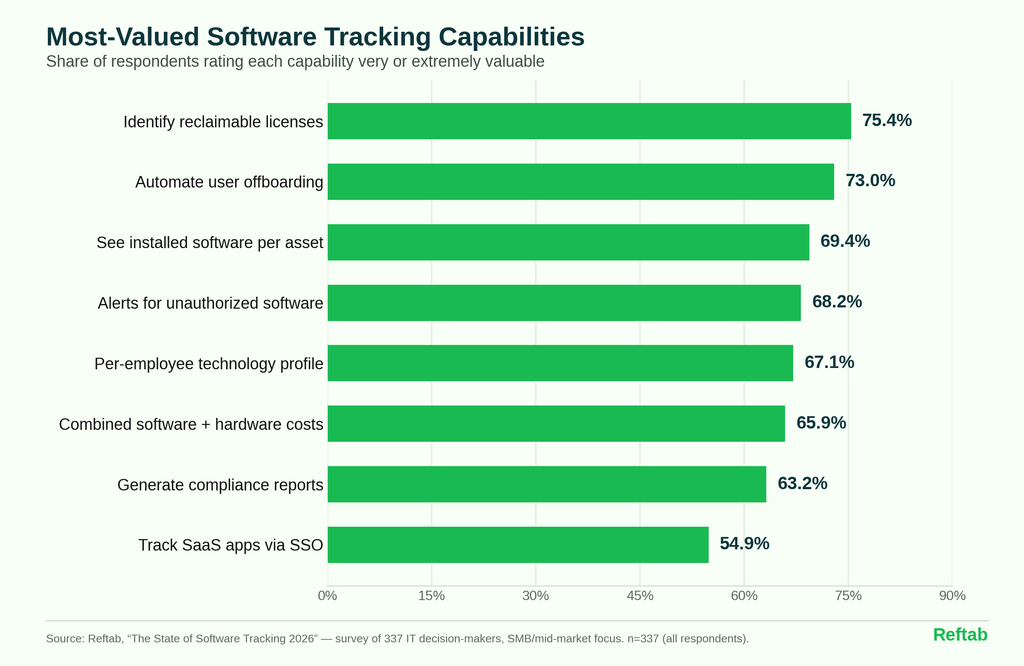
The top two capabilities center on cost recovery and access security rather than reporting. This suggests license recovery and automated offboarding are the fastest ways for IT teams to demonstrate return on investment from software tracking.
Three of the top five desired capabilities — installed-per-asset visibility, per-employee technology profiles, and combined hardware/software cost reporting — require hardware context to deliver. This is a structural argument for combined tracking, independent of respondents’ stated platform preference.
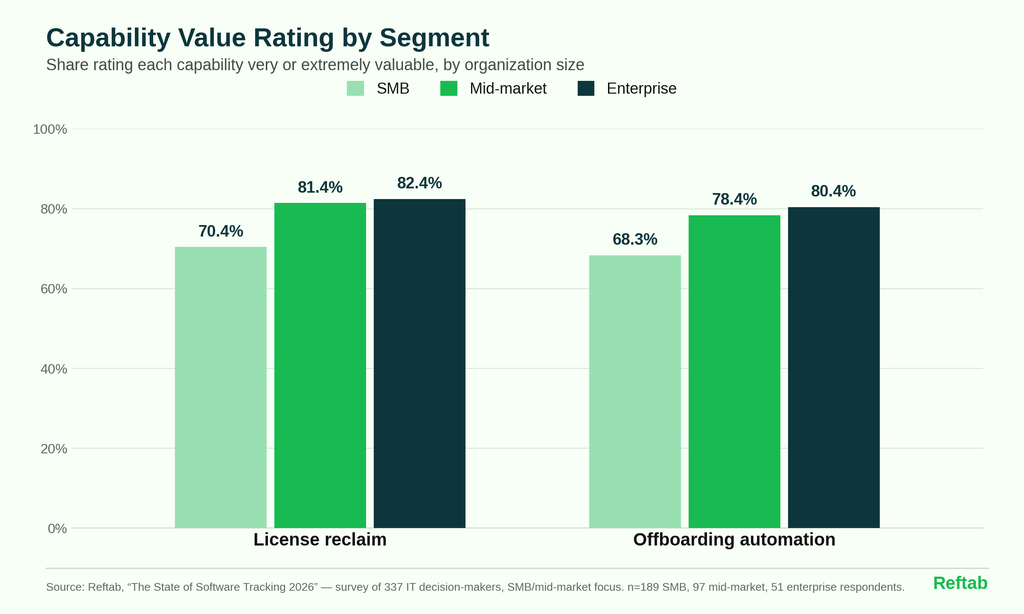
SMB and mid-market IT teams rate the capabilities most tied to consolidation lower than larger organizations do. Smaller organizations may simply have less exposure to the scale of license waste or offboarding risk that larger, more complex environments accumulate. Combined with the tooling shortfall described earlier, it suggests SMB and mid-market teams may be underestimating a problem they are structurally less equipped to solve with a standalone tool.
Specialized tools or one consolidated platform: how IT teams are deciding
Among trackers managing hardware and software with separate tools, 50.6% describe the experience as somewhat or very inconvenient. That friction connects directly to the two highest-priority capabilities in this report: license recovery and offboarding automation, the two most-valued findings overall. Both require combined hardware and software context to work — a platform that sees only software, or only hardware, cannot fully deliver either on its own.
That’s the practical factor behind the platform-preference data. 64.4% of respondents say a single view of hardware and software data would be very or extremely valuable. Asked directly about platform preference, 38.0% said they would rather use one platform that covers multiple functions, even if each function is somewhat less specialized. 20.8% prefer best-of-breed, specialized tools, even if it means managing more platforms — typically organizations with software environments complex enough to justify deeper, specialized functionality, or with the dedicated budget and headcount a standalone SAM tool requires. The remaining 34.4% said their preference depends on the specific tools involved.
Recommendations for Software Asset Management
In priority order, based on where the data shows the fastest return:
- Start with automated discovery, not a better spreadsheet. Manual effort is the primary complaint respondents report, not the practice of tracking itself. A tool that discovers installed software automatically addresses that directly. A more organized spreadsheet only makes the same manual process easier to look at.
- Audit for reclaimable licenses first. It’s the highest-rated capability in this data, and it’s usually the fastest way to put a concrete, defensible number in front of leadership. A single example of licenses going unused is often sufficient to justify further investment.
- Wire offboarding into the asset lifecycle, not just the HR checklist. Automating offboarding rated nearly as high as license recovery. Delayed offboarding is a security exposure as much as a cost one: a departing employee who retains access to multiple SaaS tools for weeks after departure represents ongoing risk.

Rachel Szarka
Table of contents
Your IT inventory, finally under control
Try Reftab for free, no strings attached. 50 assets free forever.
Continue reading

Ready to simplify IT asset management?
No credit card. No watered-down trial. Create a free account and see firsthand what Reftab can do.